
Contents: Species, Interesting Facts, Identification, Distribution, Diet, Nesting Behavior, Nestboxes, Monitoring, Nesting Timetable, Failed Nesting Attempts, More Info. Also see Chickadee Nest, Eggs and Young photos
Species: There are seven species of chickadees in North America: the Black-capped Chickadee, Boreal Chickadee, Carolina Chickadee, Chestnut-backed Chickadee, Mexican Chickadee, Mountain Chickadee, and the Siberian Tit. This webpage focuses on the Black-capped Chickadee (Poecile atricapillus) (formerly? Parus atricapillus). The alpha code for Black-capped Chickadee is BCCH.

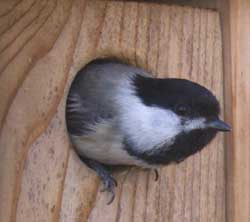
- On cold winter nights, Chickadees and Downy Woodpeckers conserve energy by lowering their body temperature by 10 to 15 degrees F. While this may seem counterproductive, “nocturnal hypothermia” probably reduces energy expenditure by as much as ten percent.
- M. Roman from Georgia had a nestbox cam on an active bluebird nest, and observed a Carolina Chickadee pecking the bluebird eggs and removing them.
- Chickadees engage in winter romance – pair bonds form as Black-capped Chickadees aggregate into winter flocks. The protection of her mate is believed to help the female have better access to food and less bullying within hierarchical flocks, enabling her to be in better condition when nesting time comes.
- Chickadees usually get the crap beat out of them by other birds (see who trumps who.) However, on occasion, they have been known to peck and remove the eggs of other birds (like bluebirds.)
Identification: Small, with a solid black cap and bib, white cheeks, greenish-gray back, white-buffy stomach, dark gray wings and long tail. Sexes look alike except males may be a bit longer and heavier. Juveniles look like adults.
Distribution: The BCCH has the largest range, from Alaska and most of Canada. They are also foundon Prince Edward Island, Newfoundland, Nova Scotia, Queen CharlotteIsland and Vancouver Island. BBS Map
In general, they do not migrate. Every couple ofyears when populations are high, birds that hatched within thepast year may “irrupt” (spread out), or move southward in the fall.
Diet: On average, BCCH eat about 70% insects (larva, caterpillars, spiders), snails, and 30% seeds and berries (e.g., sunflower, conifer, milkweed, goldenrod, ragweed any bayberry and poison ivy berries). They enjoy suet, and will eat mealworms. They cache food.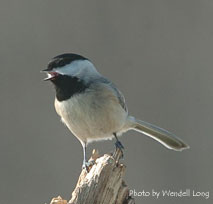
Nesting Behavior: BCCH flock in fall in winter, and then split up into monogamous breeding pairs in the spring and summer. During breeding season, they can be very inconspicuous. A BCCH will not perch on top of a nestbox it has claimed, like a bluebird, Tree Swallow or House Sparrow would. May do Snake Display.
They are cavity nesters, usually selecting a site in a rotted part of a tree, especially in stubs, snags and rotted out knotholes in forests and woodlands. Chickadees can excavate their own nest cavities, removing wood chips and dumping them away from the site to avoid attracting predators. They may use old woodpecker holes or nestboxes.
They prefer a side entrance, and if the stub or branch is slanted, the entrance is often placed on the lower surface, providing protection from the elements. Very rarely they may nest in a hole in the ground like Mountain and Chestnut-backed chickadees.
Despite the fact that they are bold around humans and at the feeder, they seldom win a competition with other cavity-nesting birds over a nest site. If you have House Wrens in your area, a Wren Guard is a good idea. They should be installed AFTER the chickadee lays the first egg to ensure they are committed to the box, and removed when the nestlings are 4-7 days old. For chickadees, the guard can be 2.0-2.25 inches away from the entrance hole. See drawings and more info.
Mountain chickadees reportedly incubated and fledged four Mountain Bluebird eggs. (Sialia, Spring 2001, Vol.23, No.2)
Nestboxes: Chickadees will nest in a bluebird box.
- In
 my experience, if given a choice, BCCHs seem to prefer to nest in small NABS style boxes, or Gilbertson PVC boxes (vs. Peterson boxes) placed in the vicinity of tree cover and bird feeders.
 - Keith Kridler of TX has seen increased use of regular boxes when he puts an empty Campbell’s soup can inside that chickadees can build their nests in.
- Initially they MAY not be attracted to a box with a hole smaller than 1.5.” There are some anecdotal reports that Canadian BCCHs have trouble entering a 1 1/8″ hole, perhaps because birds in colder climates may be larger.
- You can install a 1.125″hole guard to keep House Sparrows and other larger birds (including bluebirds) out after the chickadee starts to build a nest, preferably after the first egg is laid to ensure that they have bonded to the box. I have never had a BCCH abandon a nestbox after a hole restrictor is put on if I wait until an egg(s) is laid, but Maynard Summer of MI has. Note that this size guard will not deter House Wrens (use a wren guard instead after egg laying begins), or other native birds that often compete with chickadees for nest sites.
- Nest sites are 4-23 feet off the ground, typically 4-10 feet high.
- Cavities they excavate are generally 5″ deep x 2 3/8″ wide.
- Putting some wood shavings (not sawdust) in the bottom of the box may attract them, as they seem to prefer freshly excavated holes. (They may thrown them out as if they were excavating their own hole.)
- Chickadees have nested 15 feet away from bluebirds.
- Two pairs of Carolina Chickadees nested in boxes 33 feet apart. (A. Luebben, GA)
- Note: The box in the photo to the right has a perch on it – that’s because it is really a disabled House Sparrow trap box the BCCH’s picked. Normally boxes should not have a perch as it may enable House Sparrows to take over the box, and afford access to avian predators.
Monitoring: During nest building, some chickadees MAY abandon their efforts if disturbed, probably because they lose so many nests to competitors. Others, especially those nesting in backyards, may tolerate monitoring well. Best to wait until egg laying has begun, and if possible, wait till the female leaves the nest to check.
Tap the box or whistle to let a brooding female know you are approaching the box – otherwise she may fly into your face. She may stay nearby and “scold” during monitoring. Some chickadees sit tight during monitoring – if so, leave them be. A few will do a “snake display” – lunging and hissing – in defense of the nest.
Because of the fur plug (probably to hide and maintain temperatures) on top of eggs, a monitor may not realize egg laying or incubation have begun. Chickadee egg shells have a very thin shell, and can break even from a light touch. Gently move the plug aside, check for eggs with a mechanic’s mirror and then replace the plug.
Chickadees are prone to early fledging if disturbed. It’s probably a good idea not to open the box after they are 10-11 days old. After that date, you could look in with an automotive mechanic’s mirror if you are concerned. Note: One monitor had eggs that had not hatched in 23 days. They were removed from a nestbox, and the pair did not re-nest in that box.
- Chickadees breed the spring of the year after they hatch. Females choose their mate. Pair bonds may last for years.
- Chickadees begin exploring potential nest sites in late January or early February in some locations, if the weather is warm and sunny. They are reported to occasionally roost in a box before nest building begins.
- Excavation: Both the male and female are involved in excavation, which can take 7-10 days. (If you see a chickadee dropping wood chips from its beak, follow it back to see if you can locate a natural cavity being excavated.) A chickadee may nest in a 2″ diameter log (Keith Kridler)
- Nest construction: 3-4 days up to 2 weeks. Only the female builds the nest, which is fairly complex, starting with coarse material like moss, pine needles, or strips of bark as a foundation. Then it is lined with softer material such as animal fur/wool/hair (rabbit, deer, dog), downy plant fibers (e.g., cattails), spider webs, insect cocoons or feathers. Cup is about 1″ deep. Both chickadees and titmice will use dog/animal fur offered in a suet cage.
- Egg laying: Mid-April to early July. Usually 1-2 daysafter nest construction. Generally BCCH lay one egg per day, in earlymorning. 6-8 eggs total. As few as one, as many as 13 havebeen recorded – the average is less than 7. Eggs are tiny (2/3 inch x almost 1/2 inch) and have a dull (vs. glossy) shell. They are white with many fine reddish brown spots and streaks which are usually concentrated on the larger end of the egg. The number of eggs laid depends on age (older females usually lay more eggs), timing (the later the nest, the fewer the eggs), and latitude (northern chickadees nests usually have more eggs than southern.) When the female leaves the nest, she may cover the eggs with a “blanket” or fur plug of nesting material. (When monitoring, be sure to re-cover the eggs, as the material provides insulation and may protect the eggs from predators.) See picture of nest with eggs.
- Incubation lasts 12-13 days. It usuallybegins the day before the female lays the last egg, so that alleggs will hatch within 24 hours of each other. If eggs are laidlate in the season, incubation may start earlier. Incubationusually occurs for 20-25 minute time periods, interrupted by7-8 minutes for feeding. It is thought only the female incubates, although a nestbox cam used by Nancy Fraim on BCCH’s in PA showed both the male and female incubating, and spending the night in the box with eggs.
- Hatching: forthe first few days, the male brings almost all the food sothe female can keep hatchlings warm. They are fed several timesan hour during daylight. ByDay 12-13, both parents provide equal amounts of food, and remove fecal sacs.
- Development: Female broods at least part time up to Day 12. Day 4 – dark spots are visible where featherswill appear. Day 7 – eyes begin to open. Day 12 – eyes arefully open, insulating feather coat exists. Prone to premature fledging. Remove wren guard a week before fledging (around Day 10 or 11).
- Fledging: Day16 (earlier if nest is disturbed.)
- Dispersal: Parents feed young for 3-4 weeks afterfledging. Then the family group breaks up, and juveniles dispersefrom the area where they were born.
- Number of broods: Normally one per season.
- Failed Attempts: If a nest fails (e.g., eggs destroyed by a House Wren or another bird, a chickadee is unlikely to return to that spot to try again (on occasion if eggs are destroyed they will lay more), but they may attempt another nesting elsewhere.
- Life Span: The average life-span of a BCCH is probably about 2.5 years, the longest lived on record was 12 years 5 mos. (BNA Online)
References and More Information:
- Chickadee nests, eggs, and young photos, Sialis.org
- All About Mountain Chickadees, Sialis.org
- All about Carolina Chickadees, Sialis.org
- Nest and Egg ID (with links to species biology and photos of nests, eggs and young) for other small cavity nesters
- Bent’s Life Histories of Familiar North American Birds
- Smith, Susan M., Black-capped Chickadee (Wild Bird Guides),1997
- The Birdhouse Network
- Bluebird_L archived posts on Chickadees
- More pictures of Chickadee nests, eggs and young
- Critter Condos, Managing Dead Wood for Wildlife, WI DNR
- Annual Cycle of the Black-capped Chickadee”, by Odum, Part 2, Auk, Vol. 58, p. 518
A fun story:
- Susan Wenzel of Virginia reported chickadees bringing their three babies to the feeder. They only fed them the occasional seed. The adults took their food over to the trees to eat undisturbed, but the babies stayed on the feeder begging to whomever would listen. They even begged when the female Cardinal and a Tufted Titmice flew down to eat.
…the most engaging and characteristic enlivener of our winter woods; who revels in snow and ice, and is never lacking in abundant measures of faith and cheerfulness, enough not only for himself, but for any chance wayfarer of our own kind.
– Bradford Torrey referring to the chickadee, 1889
*
Bird, bird in the tree
Singing to me,
Singing to me!
I can see your black cap,
and hear your tune
Chickadee-dee-dee!
Chickadee-dee-dee!
You are a Black-capped Chickadee!
– Emily John
