
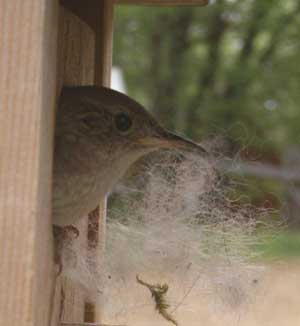
QUICK TIPS: Put nestboxes at least 50 and preferably 200-300 feet away from brushy and heavily wooded areas, especially away from areas House Wrens have used in the past. Remove all dummy nests and used nests. Try a wren guard DURING EGG LAYING (and do not wait till you hear House Wrens – put it up right after the first egg is laid for boxes near House Wren territory. Not likely to work once House Wren has discovered/used box.) Avoid slot boxes and gourds, and do not crowd single boxes together. Try staining/painting box exterior white. If you encourage House Wrens to use your boxes, I predict you will regret it in time.
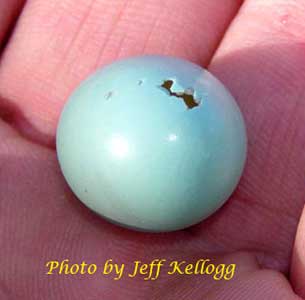
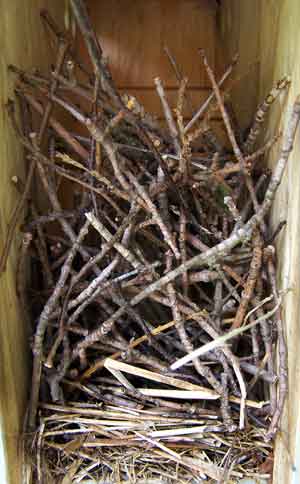
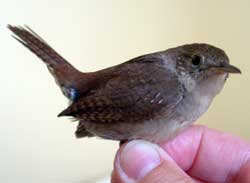
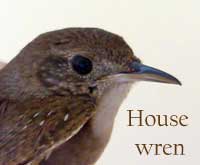
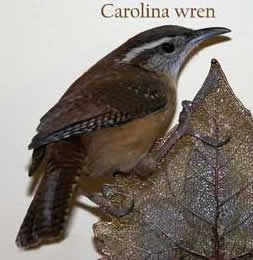
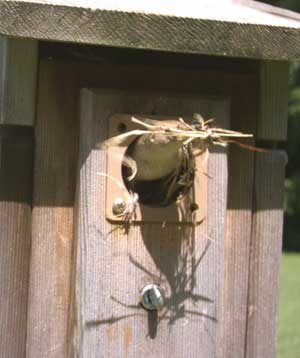
Nestbox filled to bursting with sticks and twigs? Missing eggs, or pierced/broken eggs in the nest or on the ground with no other signs, even though you have a predator guard, and haven’t seen House Sparrows around? It’s probably a House Wren (HOWR). Some bluebird trail monitors wish to deter HOWR from using their boxes because of the havoc they can wreak, and this page provides advice on various approaches. However, BE ADVISED that the HOWR is a native bird and it is illegal to harm them in any way or to interfere with active nests.
Also see All About House Wrens, Photos of Nests, Eggs and Young, Another Perspective on House Wrens, Predator ID, VIDEO of HOWR egg attack, video of HOWR removing newborn bluebirds from nest, and Other Brown Birds.
House Wrens (Troglodytes aedon or HOWR) are small, brown, common, native, insect-eating birds with a cheerful song (although it can become grating when repeated at two second intervals). They are prolific, curious, and aggressively territorial during nesting season. This habit may help reduce food competition and avoid attracting predators.
Both males and females have been known to destroy unguarded bluebird and other cavity nester’s eggs by piercing them (holes of 3 mm or less, or a large ragged hole in the middle). Eggs may be left in the nest or carried out and dropped nearby on the ground (never eaten). The whole attack may only last 14-50 seconds (Pribil and Picman, 1992.) They can remove an entire chickadee nest in a matter of hours. The intensity of egg pecking is highest in early spring, before pairs hook up. (Belles-Isles and Picman 1986.) However, males in particular will still peck eggs during incubation and nestling periods. (Pribil and Picman 1992.)
In one study in eastern MA, 20% of Black-capped Chickadee nests were destroyed by House Wrens. Althea Sherman reported that House Wrens destroyed eggs of 29 different birds. House Wrens may even displace the uncommon Bewick’s Wren. In some areas, taking over nest sites (and destruction of eggs or nestlings) is the primary reason for nesting failure for Prothonatory Warblers (Walkinshaw 1941 etc.), Tree Swallows (Tuttle 1991), and Bluebirds (Pinkowski/Radunzel 1997).
There have also been occasional reports of House Wrens killing young nestlings (e.g., 4-5 days old, in one case a report of 11-day old nestlings being killed? I would want to see that on camera) and throwing them out of the nest (Ann Wick, Linda Moore has a nestcam video showing three 1-2 day old bluebirds taken out of nest at about 8 p.m. and then again the next evening; also Linda S. reported 2 day old Carolina Wrens tossed out of box). House Wrens have also been observed filling a red-naped sapsucker nest with sticks while the sapsucker chicks were still in the nesting cavity. Kendeigh (1941) reported death of an adult bird.
In some areas, it appears that House Wrens and bluebirds peacefully co-exist. In other areas, with different birds, this is not the case.
Male House Wrens also have a habit of filling up available nestboxes with sticks to attract females/prevent competition. When not used for nesting, these are called “dummy nests.” Although they will learn to use nestboxes, unlike bluebirds, House Wrens can utilize natural nesting sites in trees and bushes. Therefore, some people choose not to encourage their use of bluebird nestboxes.
House Wrens arrive in my area (CT) later than bluebirds, so they are less of a threat during the first brood.(See nesting timetable.) However, later in the season, they can cause significant losses. They are the #1 predator on my trail, and are actually a bigger problem than House Sparrows, because you can’t remove active HOWR nests, eggs, young or trap adults.
If you have having problems with aggressive House Wrens, or wish to improve your chances of having bluebirds occupy your nestboxes, there are some techniques available, none of which are 100% effective. Remember that it is illegal to remove or destroy wren nests with eggs/fledglings, or adult wrens. Unlike House Sparrows and starlings, House Wrens are native, and protected under the Migratory Bird Treaty Act. If you decide to let House Wrens nest in your boxes, be prepared to have nothing but House Wrens in that area in the future. Learn to recognize the House Wren song – when you hear it, other nests may be in danger.
Methods of discouraging House Wren nesting (most effective methods are in bold) include removing dummy nests, avoiding marginal habitat, use of a classic wren guard, half circle wren guard, raised roof nestbox, modified Noel guard, avoiding crowded boxes, painting the exterior of a box white (not red/green), opening/plugging the nestbox, raising the height, avoiding slot boxes, avoiding gourds on trees, keeping them busy. Bob Benson was thinking of hanging a sign on his boxes that say “Not for Wrent.”Also see other methods, what doesn’t work, and other points of interest. Also see unusual House Wren nest made almost entirely of grass.
METHODS OF DETERRING HOUSE WRENS
Avoid marginal bluebird habitat. Installing/moving nestboxes at least 50 and preferably 200-300 feet away from brushy and heavily wooded areas (thickets, brambles, trees or shrubbery, brush piles), or riparian areas (next to streams, etc.) may decrease the likelihood of House Wrens using the box. If it is an option, place boxes near conifers, instead of near deciduous trees. (However, I’ve had HOWR use boxes in the middle of Christmas tree fields.) Removing brush near a box may also help. Shrubbery appears to be a bigger attractant than trees. Facing the entrance hole away from shrubbery may help a bit. Some people have had success with boxes 40-100 feet away from shrubbery – others have had House Wrens use boxes over 1,000 feet away from wooded areas.
House Wren populations appear to be increasing. As nesting pressure increases, or as the season progresses, they may move farther and farther away from what is considered “ideal” House Wren habitat. The size of a HOWRs territory is not known, but may be about 100-230 feet from the nest site (about 1 to 2.3 acres).
Dr. Kevin Berner believes that moving boxes away from HOWR habitat, especially boxes used in the past by HOWR, is the best deterrent. (see article) Unfortunately chickadee and titmouse habitat often overlaps with House Wren habitat.
Avoid crowded single boxes: House Wren populations may have grown in some areas due to the proliferation of tiny ornamental boxes in backyards. The Bluebird Recovery Association of Wisconsin found that crowded single boxes (multiple boxes 100 feet to 100 yards apart) seemed to attract both House Wrens and House Sparrows. There were fewer HOWR in boxes 100 yards apart (and more bluebirds.) Abundant boxes may create more problems for the declining Bewick’s Wren. (There is a report in Bent that Tree Swallows and House Wrens occupied different compartments of the same Purple Martin house.)
Remove extra boxes: An alternative approach is to have fewer boxes, so House Wren populations don’t explode, and the HOWR don’t attack neighbors’ nests. For example, just have one box in a yard, and use a wren guard on it once an egg is laid.
Avoid slot, Gilbertson and Gilwood boxes especially near typical wren habitat. The slot opening seems to make it easy for House Wrens to bring sticks in, which may make the box more attractive. House Wrens may also be attracted to Gilwood boxes, which have a larger opening. Both the Gilwood and Gilbertson have small interiors. Try boxes with larger floor size, as House Wrens may prefer smaller floors. However, I did see a House Wren dummy nest in a Zuern tree branch box. Avoid gourds hung on trees: House Wrens seem to be attracted to these. (Unfortunately, harmless Carolina Wrens also like them.) Also, it is not possible to clean out natural gourds.
Paint the exterior white, avoid red or green. In one study, when HOWR were given a choice of red, yellow, blue, white and green nesting boxes, they preferred red and green, and used white the least. (McCabe, 1960.)
Open or plug box. Plug up a nestbox (a $1.79 rubber drain plug works well) where you have found dummy nests, or leave the door to the box open for 3-7 days up to 2 weeks if House Wrens attempt to claim the box. The problem with this method is that it may encourage the wren to attempt to claim another nestbox that has other birds actively nesting in it.
Dummy nests (no lined nest cup with feathers or eggs) may be removed and destroyed. Dummy nests generally consist of loose sticks only (no lining of feathers or fibers.) They seem to sometimes (but not always) lack the white fuzzy spider cocoons that House Wrens use on active nests.
A nest with a lining would be considered an active nest and must be left alone under the Migratory Bird Treaty Act. You can assume a nest is a dummy if it has no eggs in it after 3 weeks. DO try to determine that the source is a House Wren, and not a Bewick’s Wren, which is uncommon or in decline in some areas. More info on dummy nests.
You may need to repeatedly remove the sticks and twigs or a dummy nest, or leave the box open or plugged for a week or two. Removing sticks usually requires daily visits, as a HOWR can fill up a box in a day. If they intend to use the box for a nest (i.e., it was not a true dummy nest) the pair may begin refilling the box within minutes. Don’t put the sticks on the ground near the nest, as this makes HOWR reuse easier. Removing nests seems to deter HOWR less than loss of eggs to a predator.
One of the reason I remove dummy nests is that other birds will avoid using a box that has dummy nest sticks in it. However, note that removing sticks may signal to another species that the box is available, setting them up for loss of eggs/young if the HOWR keeps trying to use the box.
Try a modified Noel guard: Suggestion from Bernie Daniel: When a Chickadee or bluebird is established (i.e., a nest or eggs) build a “vanity front porch” on the box for them. Cut an old 2 quart milk carton in half. Cut a 1.5′ hole in the bottom. Trim back the sides to about 4″ in depth (now you have created a 4″ bowl with a hole the bottom.) Center the hole in the bottom of the former milk carton over the nestbox hole and tack it onto the door. You can cut the bottom of the “porch” off so it is easier to attach and so that the Chickadee has access to the wooden door — but keep the sides and top in place. (Basically this is a just a plastic “Noel guard” with no bottom). This creates a vestibule that prevents the wren for seeing the chickadee fly into the hole. Thus, the wren has less interest in what the chickadee is doing. Daniel has never lost a nest to wrens since using this method.
Keep them busy: Put up a number of wren houses without predator guards in a very small area in prime wren habitat, away from bluebird boxes. Then continually remove the dummy nests. This may keep the males occupied so they don’t have time to attack. Boxes should have 15/16″ holes. Tree Greenwood uses 6-20 or more. If you do this where there are Bewick’s Wrens, and House Wrens use crowded boxes, it could contribute to further decline of the Bewick’s, which does not compete well.
Clean out old nests: in some populations, cavities with HOWR nests are preferred over empty cavities, perhaps because they may indicate prior successful use. Therefore, at the end of nesting season, clean out used nests.
Mount boxes higher up. Some (including me) have found mounting boxes at this height is not a deterrent. HOWR have been reported nesting 10.5-30 feet high. The NY Bluebird Society reported that house wrens have used kestrel boxes 17 to 20 feet off the ground.On urban trails where boxes hang high in trees, but away from shrubbery, others find House Wrens are not generally a problem. For some reason, House Wrens seldom nest in purple martin nestboxes, which are generally 12 feet or more off the ground.
WREN GUARDS
Try a wren guard. To prevent House Wrens from using nestboxes, make the hole “invisible” by putting up a thin (view blocker) L-shaped piece of wood that extends from the front edge of the roof to just below the entrance hole. It needs to be about as wide as the box front, and extend below the hole. The guard basically obscures the hole from view. See drawings and instructions below.
This clever device was invented by Bob Orthwein. Reports of effectiveness of this measure are mixed – some have found them very successful. It may work because House Wrens tend to perch on the roof and then enter the box, or fly in from short distances.
- DO NOT PUT IT UP BEFORE THE FIRST EGG to avoid abandonment. TIMING: Watch the box after installation to verify that the nester is able to enter. DO NOT PUT A WREN GUARD UP AFTER EGG LAYING IS OVER unless you VERIFY that the parents will enter the box, especially with other species like Tree Swallows! If the parents refuse to go inside to incubate, brood or feed, the eggs or babies WILL ALL DIE! Putting up a wren guard before egg laying begins may result in nest abandonment with some species (e.g., chickadees, titmice.)
- Put up the guard after the first egg (or two or three) of the desired-cavity nester has been laid. This is because:
- you want to the desired cavity nester to realize it is a nestbox;
- if you put it on while they are checking it out or during nestbuilding, they may go elsewhere.
- Once they lay an egg they are more “committed” to the box.
- On occasion, people like Joan Watroba have put the guard up during nestbuilding by bluebirds BEFORE an egg was laid, and have had it accepted, especially if the parents are tolerant of monitoring, but try to avoid this.
- Pam heard HOWR singing and put up both a hole reducer and a wren guard before the chickadees laid eggs. It was accepted by both the male and female after three attempts and a lot of “Dee-dee-deeing,” and they went on to lay eggs.
- They have more time to get used to it without interrupting incubation, brooding or feeding and
- You can confirm acceptance by seeing a new egg the next day
- Per above, DO NOT WAIT till you HEAR House Wrens if the box is in House Wren territory (e.g., near brush/wooded areas.)
- DO NOT WAIT until you HEAR House Wrens – sometimes the male does not sing when he first arrives in an area. (I often only realize they are in town when I catch them checking out boxes with my motion-activated birdcam.)
- I tried a wren guard after a House Wren began removing a chickadee nest from a box. The wren flew right underneath the guard. Perhaps they only work or are MORE likely to work if they are put up before the wren has entered a box, AND in a box that a House Wren has not nested in previously. On other occasions, House Wrens that had already entered a box left it alone after a wren guard was installed – maybe the guard made it too inconvenient.
- Remove the guard when bluebird hatchlings are about 4-7 days old, as it may interfere with fledging. In addition, the female has to clamber to get into the box under the guard, which slows her down. It’s also probably somewhat easier for the parents to feed without the guard in place. (For smaller nestlings like chickadees or titmice, wait till day 10 or 11, up to day 14.)
- Note: Wren guards may also deter Tree and Violet-green swallows from harassing nesting bluebirds.
- Some bluebirds may learn to better defend their eggs/young after a initial House Wren attack. A wren guard may help, even though they appear to be less effective after a HOWR has attacked once. The problem is that House Wrens are VERY quick and sneaky.
CONSTRUCTION AND INSTALLATION
- Ideally the guard should be made of the same material as the box so it blends in. In a pinch you can even make a temporary one with a piece of cardboard attached with duct tape.
- It should block the view of the hole, and be a little wider than the hole on both sides.
- Position it just below the hole, and as close to the front of the box as possible to still allow the nester to enter – Orthwein recommended 2.0 to 2.25″ away from the entrance hole – 2.5-3″ for bluebirds. I often put it even farther away to make it easier on the parents.
- It is harder to monitor the box with a guard installed if it has a front-opening door. A bendable connection to the roof (like a piece of tin) will allow it to flex when you open the door for monitoring.
- You have to make your own, as they are not commercially available, in part because boxes are so variable. (Bluebird Loves, which is apparently out of business, used to sell one designed especially for their box.)
- If you have a Jack Finch box with a metal roof, Horace Sher suggests a 3″ x 4″piece of cardboard fit in between the metal roof cover and the actual roof.
- Also see untested variation which I did not find successful.
Acceptance of wren guards different species: by Black-capped Chickadees (BCCH), Carolina Chickadees, Tufted Titmice and Eastern Bluebirds has been documented.
- Different species and Individual birds can vary in terms of “nervousness.” It may take the parents minutes to hours to adjust to a change like this. This is why it’s generally best to put it up while eggs are still being laid, so you don’t interrupt incubation, and can confirm acceptance when the next egg is laid. See drawing and more photos below.
- Chickadees: When I put a guard up on one chickadee box after eggs had been laid, it was accepted in less than one minute. Another BCCH took 7 attempts in 7 minutes (she was already incubating, but the top of this guard was shiny metal which may have been a problem.) One person reported 24 attempts by a chickadee until it actually entered the hole.
- Bluebirds tend to be more tolerant than other species of box changes, and it may even be wise to put up the wren guard as soon as the bluebirds start a nest, since once the House Wren finds the box, the guard is less effective at deterring them. A few people report individual female bluebirds that will not accept them. I have seen females accept them more quickly than males.
- Tufted Titmice: I have had titmice abandon nests before eggs are laid, so I strongly recommend waiting for an egg.
- Tree Swallow: Darlene Sillick has used them successfully on Tree Swallow nestboxes. I definitely recommend installing it during egg laying. I lost a nest of Tree Swallow hatchlings during cold weather when the parents refused to accept it. Ideally, watch the box to confirm acceptance (even if it means waiting an hour.)
WREN GUARDS – see drawing
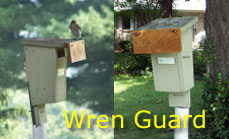
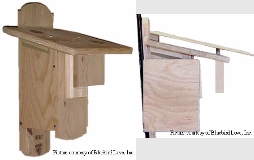
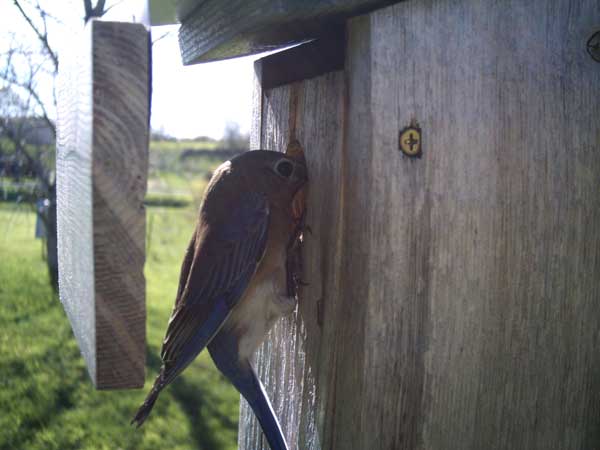
Note: Some people have found that wren guards also help with deterring harassment by House Sparrows.
On a box with a large roof overhang, or on a Peterson box, try a wren guard with “ears” (side guards) that wrap around the sides too – the Missouri Bluebird Society has found this is more effective in deterring House Wrens.
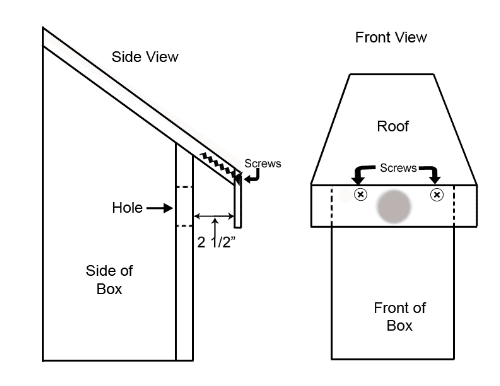
INSTRUCTIONS:
Distance from front to guard should be 2.5″ for bluebirds. 2.0 to 2.25″ is okay for smaller birds like chickadees. I usually put them a bit further out (3-4″)
- You can make a wren guard out of paint sticks. One person made one out of a cereal box (put the plain side facing out), which was flexible enough for a front opening box, and endured rainy weather. The guard doesn’t have to last forever, since you remove it when the nestlings are 4-7 days old.
- Some people are experimenting successfully with wren guards that also have sides on them (e.g., Dick Tuttle tried plastic landscape edging that curves). However, others report that Black-capped chickadees enter from the sides.
Making your own wren guard:
Materials:
- 1 precut piece of aluminum step flashing (costs about 20 cents – some come pre-bent
- 1 white cedar shim shingles (a set of about 6 costs about $1.20) or piece of lightweight wood
- 6 very short screws
- 3 slightly longer screws (that will attach guard to roof.)
-
Bend the flashing at a 90 degree angle in the middle if it did not come pre-bent.
-
Cut two pieces of shim shingles – #1 to secure the guard to the roof, and #2 to hang in front of the entrance hole. #2 should be slightly wider than the box, and extend just below the hole. (You can also punch holes in the flashing and attach that directly to the roof.)
-
Using two short screws, attach the flashing to the inside of piece #1. Predrill holes so you don’t split narrow wood. Make sure screw ends don’t poke out.
-
Measure guard on box, to ensure that the distance between piece #2 and the front of the box will 2.5″ for bluebirds, or 2.0 to 2.25″ for smaller birds like chickadees.
-
Screw #2 to flashing (flashing on inside, facing box, wood side facing out).
-
Screw #1 to the roof of the box, using 3 screws in a triangle to help hold it in place. #2 should hang dead vertical in front of the box entrance. Double check distance.
-
Remember to remove the guard after babies are 4-7 days old to make it easier for adults to feed and babies to fledge.
Other suggestions on deterring wrens:
- Try putting a nestbox very close to an active House Wren nest (i.e., 1 to 5 meters) as the Wrens MAY avoid it, perhaps because they are inhibited from pecking eggs near their nest, again perhaps to keep their own eggs from being destroyed (Pribil & Picman 1992.) The researchers found a box 15-25 m away from an active HOWR nest was MORE likely to be attacked. The study by Pribil showed that wren depredation seldom if ever occurs if the other birds’ nestbox is closer than 3 to 16 feet of the wren’s nest. If you’re experiencing egg-pecking, find the wren’s nest and either move your nestbox in close to it, or move it out over 130 feet. Some research indicates that wrens destroy others nests only when they have their own nest within 20 ft to 30 ft of another nest.
- (Jimmy Dodson of MO reported no attacks in a paired box situation, with Tree Swallow eggs in one, and HOWR eggs in a box 10 feet away that were laid before the TRES started laying).
- Orthwein Raised Roof nestbox: A raised roof nestbox designed by Bob Orthwein, who also designed the Wren Predator Guard. Dr. Berner tested it and did not find it very effective.
- In some studies, male HOWRs attacked eggs only before pairing, and females only before laying. (Hannon and Cotterill 1998, Kennedy and White 1996, White and Kennedy 1997)
- If House Wrens begin nesting later than bluebirds in your area (this is generally the case in Connecticut), remove/plug/leave open nestboxes after the first bluebird nesting is complete. Of course this makes the boxes unavailable for a potential second/third brood of bluebirds.
- Remove the predator guard from a box occupied by nesting House Wrens.
- If eggs were laid and the door to the nestbox left open, it might prevent incubation, however this would probably be considered “harassment” under the Migratory Bird Treaty Act. Once the eggs hatch, the HOWR is not likely to abandon.
- Construct decorative bird houses without a floor so they are not used by House Wrens or House Sparrows.
- If bluebirds have claimed the box (before eggs are laid), plug up the hole in late morning after each egg is laid, and then unplug it in the evening until laying is finished (4-5 eggs?)
- Note: This seems time consuming; House Wrens may still peck eggs after laying is complete while parents are out foraging; and I don’t know whether this might lead to nest abandonment.
- If wrens are nesting in one box, and filling up other boxes in their line of sight with dummy nests, try moving the other boxes (so visibility is blocked.) I have NO idea whether this would work.
- Half Circle Wren Guard: At the 2004 NABS convention, a new style of wren guard was on display. It is a c-shaped
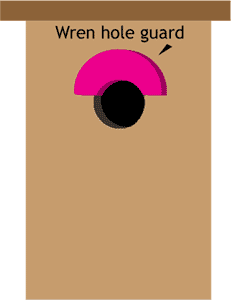 wooden arch (same thickness as front panel) that is placed over the top of (and lined up with) the entrance hole. It does not block the view of the hole like a traditional wren guard. Supposedly it makes it difficult or impossible for wrens to enter the box, since they cling to the bottom of the entrance hole with a twig in their beak, and the extra thickness prevents them from getting closer to the box while still holding the twig. However, wrens rotate the twig in their beak so the twig sticks out like a drinking straw and then enters the box. Also, if they can still enter the box and destroy eggs and young nestlings, it might not be worthwhile. Additional information on the performance of this approach is desired – if you have experience, please contact me. To make one, take a square block of wood, put a 1 1/2 inch entrance hole in the middle of it, and then saw it in to two pieces where the saw cut would be through the center of the entrance hole. This would make two guards where each could be installed, with two nails or screws, as an “arch” above your present nestboxes entrances. For doors that open from the bottom, make sure the arch doesn’t interfere with opening. Not suitable for a Gilwood box.
- Testing: I tried this guard on three boxes. Two of the boxes had been occupied by House Wrens the prior year; both were occupied in the subsequent years despite the guard. Experience with the box may have overcome any deterrent effect it might have had. I put it on a third chickadee nestbox near House Wren territory and the chickadees hatched successfully. It took the incubating female three flights over an 8 minute period to check it out before accepting the guard. After the chickadees had fledged, a House Wren placed sticks in the box. Personally, I doubt whether any wren guards work well once a House Wren has discovered a box.
What usually doesn’t work:
- I am not aware of any “wren-proof” or even wren-resistant bluebird nestbox. I don’t know of any cavity nesters that are smaller than a House Wren, so they can fit in any hole another bird could get through.
- Extra boxes: Some people put up additional wren boxes/gourds closer to brush, at least 120 feet away from other nestboxes. Holes should be 15/16 of an inch to exclude House Sparrows. However, this can be expected to increase your local wren population and future nestbox competition as a result. Dean Sheldon found that: “This works well for the FIRST GENERATION of HOWR nesters, but….after the fledging of the HOWR chicks, the parents move on out into unexplored territory and will, then, occupy the nest boxes in the open areas. In addition, the young of those first/second nestings may well return to their natal site next year to further exacerbate the HOWR occupancy of the entire territory.” Predation may be highest in areas where the population is highest, so increasing the local population would only make things worse. See Keep Them Busy option.
- Apparently mono-filament and sparrow spookers do NOT deter House Wrens.
- Skylights (part Plexiglas roofs) in hanging boxes or open topped boxes also do not effectively deter House Wrens.
- Placing a tin/tub of water on the nestbox floor does not deter wrens, as they may build their nest on top of the container.
- A small rubber snake. I put one with it’s head and tongue sticking out of the hole in a box where House Wrens had started building. They were curious, but appeared unafraid, and within a minute or so tried to pull the rubber snake out through the hole. Eventually they built their nest right on top of it.
- Hanging boxes. HOWR will use them.
- Thick wooden guards placed over the face of the nestbox hole do not deter HOWR.
- A mirror inside the box doesn’t deter House Wrens.
Other points of interest:
- The first year on my trail I had, I did not have any House Wrens nesting. The next year, one box was occupied by House Wrens. The following year, there were 13 active or dummy wren nests. I no longer allow them to use my nestboxes, by leaving the door open if they attempt to claim a box.
- Once wren egg laying is complete, destructive tendencies may subside. In three studies, researchers found that males attacked eggs only before pairing up with a female, and females only attacked eggs only before the laying period. However, there are anecdotal accounts of egg destruction outside of those time frames.
- However, after laying their own eggs, one person reported HOWR destroying nuthatch eggs in a nest 60 feet away.
- A researcher at Michigan State University put plastic “craft store” eggs in a fake nest in a nestbox. The next time the boxes were checked, all the eggs were out of the boxes. They had to wire the eggs in place, even then all the eggs had holes pierced in them. Not all boxes that had eggs removed were used for nesting.
- House Wrens nestlings are prone to premature fledging if the box is monitored too late in the cycle. Several people have captured and returned a prematurely fledged birds to the nest and they remained (unlike prematurely fledged bluebird nestlings, which typically will not remain in the box.)
- It’s possible that nuthatches may coat the entrance of their cavities with pitch to deter HOWR. Nuthatches enter the hole without touching the sides.
- Wrens can enter the side ventilation holes on a Gilbertson PVC box.
- There are some anecdotal reports that HOWR move further into open areas later in the nesting season.
- I believe forest fragmentation is probably creating more habitat for House Wrens, which may be resulting in population increases in some areas. More on forest fragmentation.
- Usurpation of nest sites by House Wrens, sometimes accompanied by destruction of eggs or nestlings, is primary source of nesting failure for other cavity-nesting species, including Prothonatory Warbler, Tree Swallow, chickadees, and bluebirds (Walkinshaw 1941, Kluyver 1961, Brewer 1963, Finch 1990, Rendell and Robertson 1990, Tuttle 1991, Brush 1994, Flashpoler 1996).
- “Damage by wrens may be reduced in Black-capped Chickadees, Tufted Titmice and other parids by concealing eggs under nest material during the laying period. To test if eggs were protected by covering, prelaying wrens were challenged for 1 day with a set of two boxes placed 1 m from their nest, one with two artificial eggs (miniature marshmallows) lightly covered under fur, the other with two artificial eggs in an open cup. Results varied with stage of nest-building; in 41 trials where both exposed eggs were removed, covered eggs remained in only 4 of 15 (27%) trials near early nests containing few sticks, but in 17 of 26 (65%) trials near more advanced nests. To assess effects of nest site, a box with a cup nest was placed in each of three habitats 10 or 20 m from 29 wren nests. After 1 day of habituation, two artificial eggs were placed in each nest and left exposed for 1 day. Boxes in woodland interiors were less likely than boxes in fields and along edges to be visited by wrens at least once over 2 days (66 vs. 97% visited) and were less likely to have eggs removed (10 vs. 83% removed). Competitors for nesting cavities also may escape attacks by wrens through differences in breeding period, active defense of territories or nests, or re-nesting” (Effect of Egg Covering and Habitat on Nest Destruction by House Wrens Douglas W. White, E. Dale Kennedy The Condor, Vol. 99, No. 4 (Nov., 1997), pp. 873-879)
House Wren Nesting Timetable: See House Wren Biology
-
House wren nest, eggs and young photos (Sialis.org)
-
House Wren (ID and song)
-
House Wren – info, song, description from Cornell website
-
House Wren by Lisa Mitchell
-
House Wren, AC Bent’s Life Histories of Familiar North American Birds
-
Wren species ID (E-Nature)
-
Wren Guards by Bob Orthwein
-
Down with the House Wren Boxes by Althea Sherman
-
The Great Wren Debate Revisited – by Barbara Boyle
-
House Wrens and open-topped nest boxes by Kevin Berner
-
Bluebird_L discussion on Problems with House Wrens on Bluebird Trails
-
Article by Karen Lippy in defense of House Wrens
-
Wrens – Pennsylvania Game Commission
-
Wren maneuvering a stick into a box (video clip – The Bluebird Nut) and audio files of song and chatter.
-
House Wren song recorded by Cher Layton, The Bluebird Nut
-
Dummy and Abandoned Nests, Sialis.org
-
Nest and Egg ID (with links to species biology and photos of nests, eggs and young) for other small cavity nesters
-
Forest fragmentation – impacts, our Better Nature
-
Selection of Nest Boxes by Wrens, McCabe, Robert, July 1961, Dept. of Forestry and Wildlife Management, University of Wisconsin, published in Condor, Vol.63, p. 322-329, retrieved from https://sora.unm.edu/sites/default/files/journals/condor/v063n04/p0322-p0329.pdf
-
Belles-Isles, J.C., and J. Picman. 1986. House Wren nest-destroying behavior. Condor 88: 190-193.
-
Pribil S. and J. Picman, 1992. Why House Wrens destroy clutches of other birds: a support for the nest site competition hypothesis. Condor 93: 184-185.
-
Pribil S., date? An Effective Trap for the House Wren, North American Bird Bander, Vol.22, No.1, p. 6 – 9
– Andre Dion, The Return of the Bluebird, 1981
