
CONSPECIFIC (or Intraspecific):
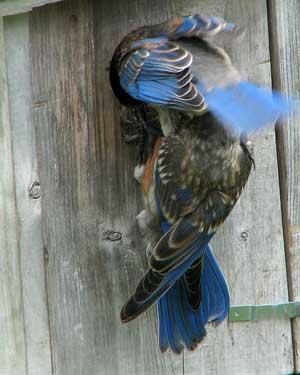
Bluebird juveniles or adults may help other breeding bluebirds feed nestlings, remove fecal sacs, defend the nest, etc. See video. This is called helping by conspecifics.
Joint nesting between conspecifics can also occur – e.g., two female Prothonotary Warblers nested simultaneously (with a combined clutch of 9 eggs) in the same cavity. (Loucks 1894 BNA) This may be costly to the nestlings, as they are more likely to starve when there are more mouths to feed. Dr. David Pitts reported two females who laid a total of nine eggs in one box (with one male), incubated the eggs side by side (head to tail) and successfully fledged nine young.
Red-cockaded Woodpeckers routinely have one to five (up to nine) helpers living in clusters with and assisting a breeding pair. Helpers are usually children of the breeding pair. If the breeding male dies, one of the male helpers (usually the oldest) is “promoted” to breeding male, and the female will leave (since she may be related.)
HETEROSPECIFIC (or Interspecific):
Helping between different species (called heterospecifics) has also been observed. This is referred to variously as cross-species/conspecific/interspecific feeding or helping, alloparenting, cross-fostering or brood adoption.
Marilyn M. Shy listed 65 different species of birds observed feeding or adopting birds of 71 species. (Shy, 1982.) Another researcher, Marianne Riedman, listed 150 species of birds that adopted the young of another species. (Riedman 1982)
Why would birds do this? It doesn’t help them pass on their own genes, or appear to help the survival of their species as a whole. Maybe the “helping” bird:
- can’t resist responding to a begging baby bird (which may or may not be orphaned or neglected): stimulus: response
- its own nest/babies were destroyed (e.g., in a storm, or by predators) or a nesting attempt failed
- could not find a nesting spot
- is nesting nearby (sometimes the interloper will be attacked, other times there is no antagonism), with attention often going to the first brood that hatches
- doesn’t have a mate, but seasonal hormone surges are driving reproductive type behavior
- a male whose mate is busy incubating (so he has spare time)
- younger/inexperienced birds “practicing”
- was itself adopted by another species when it was young (i.e., raised in a mixed clutch)
- some combination of the above.
The helping bird may be an adult or juvenile, male, female, or a pair of birds.
EXAMPLES of Heterospecific Helping involving cavity nesters:
- Swallows: A “cooperative” relationship between Violet-green Swallows (VGSW) and Western Bluebirds was observed in Oregon, in which swallows helped defend the nest and care for young bluebirds. Three pairs of adult VGSWs visited Western Bluebird nests after foraging (presumably to feed nestlings), removing fecal sacs and defending nest sites against predators. (Eltzroth and Robinson 1984) In two cases, the VGSWs had failed nests nearby, and two of the pairs took over the cavities after the WEBL nestlings they had helped fledged.
- Chickadees: Two color-banded adult male Carolina Chickadees and 1 female tended same brood of nestlings and fledged young in Carolina/Black-capped hybrid zone population in SE Pennsylvania, possibly following death of mate of one of the males (RLC and K. L. Cornell unpubl.). Species status of individuals involved uncertain, although all 3 adults involved had Carolina mtDNA haplotypes (Cornell 2001).
- Pygmy Nuthatch: A Pygmy Nuthatch was observed feeding Mountain Bluebird nestlings and removing fecal sacs. The nest was located in a tree in Nevada County, CA (June 2014 – see great photos)
 Brown-headed Nuthatches: Two BHNU’s were observed feeding bluebirds in a nestbox. They constantly delivered spiders. The bluebird parents initially tolerated this, but after about 1.5 weeks, the male bluebird began chasing the nuthatches off. The nuthatches did not enter the box – they sat at the opening while feeding. (Carl Johnson, Myrtle Beach, SC, 2015 – see photo)
- Woodpeckers: (panhandling)
- A Hairy Woodpecker fed a begging fledgling Downy Woodpecker (Davis 1973)
- A Red-bellied Woodpecker fed a begging Tufted Titmouse fledgling. (Curry 1969)
- House Sparrows:
- In Detroit metro area, a female House Sparrow (HOSP) was raising 3 bluebird young. The sparrows chased away the bluebirds and took over the nestbox with bluebird eggs in it. (Kurt email)
- Tree Swallows allowed a juvenile House Sparrow to feed nestling Tree Swallows (the Swallows drove off older House Sparrows.) (Porcher pers. comm with Shy)
- House Finches: “Two instances of Western Robins and House Finches using the same nests have come to our attention during the past three years. In May, 1934, we were informed that House Finches were feeding young robins in a nest on a front porch in east Denver, Colorado. On investigation we found four half-grown robins, two newly hatched finches and four finch eggs. There were two female finches apparently with the same mate, and the three finches and the two adult robins fed the young regularly. Unfortunately, however, the large robins smothered their small nest mates. We did not determine whether the four remaining eggs hatched. All three adult House Finches fed the young robins in the nest, and after the young had left the nest. On May 15, 1936, in a similar instance, the nest was on the back porch of Bailey’s home, 2540 Colorado Blvd., Denver. The young robins were nearly ready to leave the nest, and there was no evidence that the pair of House Finches had laid eggs. However, both adult finches and robins fed the young regularly. The male finch was particularly solicitous and would alight on a wire a few feet from the nest and sing whenever one of the other birds brought food. The young robins left the nest May 20, and the finches were the only ones noted feeding them from that time one, although the adult robins were about and no doubt shared the responsibility. ” (from from Life Histories of Familiar North American Birds, reported by A.M. Bailey and R.J. Neidrach in 1936 in Denver)
- Eastern Bluebird:
- A male Eastern Bluebird fed nestling House Wrens while his mate incubated, and later neglected his own young. He even fought the parents of the wren nestlings over feeding the wren babies. (Forbush 1929)
- In 2015, Linda Schamberger observed a female bluebird helping to feed the Tree Swallow nestlings at the paired box she had on the trail. The female only had 3 bluebird nestlings to feed in that brood while the 6 Tree Swallow nestlings were making much chatter in the box next to them, so mother bluebird would feed her own and then help tend /feed the tree swallow nestlings.
- Starling: fed nestling Purple Martins after the starling eggs were removed from a martin house (Brown 1977a.) Two starling nestlings fed by a pair of Eastern Bluebirds (Tami Gingrich, 2000, Bluebird journal)
- Carolina Wren: a male Carolina Wren fed Great Crested Flycatcher nestlings while his mate was incubating, but gave up after several fights with the birth parents. (Wight 1934)
- House Wren:
- A mate-less House Wren fed adult Black-headed Grosbeaks sitting on a nest, and was later observed feeding a family of house Sparrows (Hill 1924.) (Hills 1924. It is rare to find other species feeding House Sparrows – Shy found only 2 records.)
- A mated male (with an incubating mate on a nest 40 cm away) fed nestling Northern Flickers for several days. After his own eggs hatched, he fed both broods. (Broyall and Pillmore, 1968.)
- Robin: I guess it makes sense to often find bluebirds and robins together as they are both eating insects from the ground. A robin shared mealworms with a bluebird family of six. She’s generally pretty polite, takes her worms and hops off the stump. The other day, she flew over when one of the fledglings was on the stump with Mom and Dad crying for food. Mom and Dad flew away, but the fledgling stayed, and the robin put mealworms in its mouth. (Gia, Bluebird_L, 6/10/08)
BROOD PARASITISM
Cowbirds are the only obligate brood parasites in North America. Cowbirds don’t build their own nests. Instead, they generally remove an egg from another species’ nest, replace it with one of their own, and then rely on the surrogate parent to incubate the egg and rear the nestling. More on cowbirds….
EGG DUMPING
Egg dumping is when a female bird lays her egg(s) in the nest of another bird, sometimes creating very large clutches. Egg dumping is not uncommon with chickadees and wood ducks. More on egg dumping….
Related Pages:
- Allofeeding
- Cowbirds
- Egg Dumping
- Mating among bluebirds (pair bonds)
- Helpers (video of bluebird juveniles feeding nestlings)
References:
- BNA
- Brown, C.R. 1977a. Starling feeding Purple Martins. Southwest. Nat. 21:557-558
- Curry, J.R., 1969. Red-bellied Woodpecker feeds Tufted Titmouse. Wilson Bull.81:470
- Davis G.L., 1973. Hair Woodpecker feeding immature Downy Woodpecker. Kingbird 23:189
- Forbush, E.H. 1929. Birds of Massachusetts and other New England states. Vol.3, Mass.Dep. Agric., Boston
- Johnson L. Scott et al, The cost of polygyny in the house wren Troglodytes aedon, Journal of Animal Ecology, 1993, 62, 669-682.
- Riedman, Marianne L. (1982). “The Evolution of Alloparental Care and Adoption in Mammals and Birds”. The Quarterly Review of Biology 57 (4): 405–435.
- Shy, Marilyn Muszalski (1982). “Interspecific feeding among birds: A review.” J. Field Ornithol.
- Wight, E.M. 1934. Attracting birds at Chattanooga. Migrant 5:46
– Shirl Brunnel, I Hear Bluebirds, 1984
